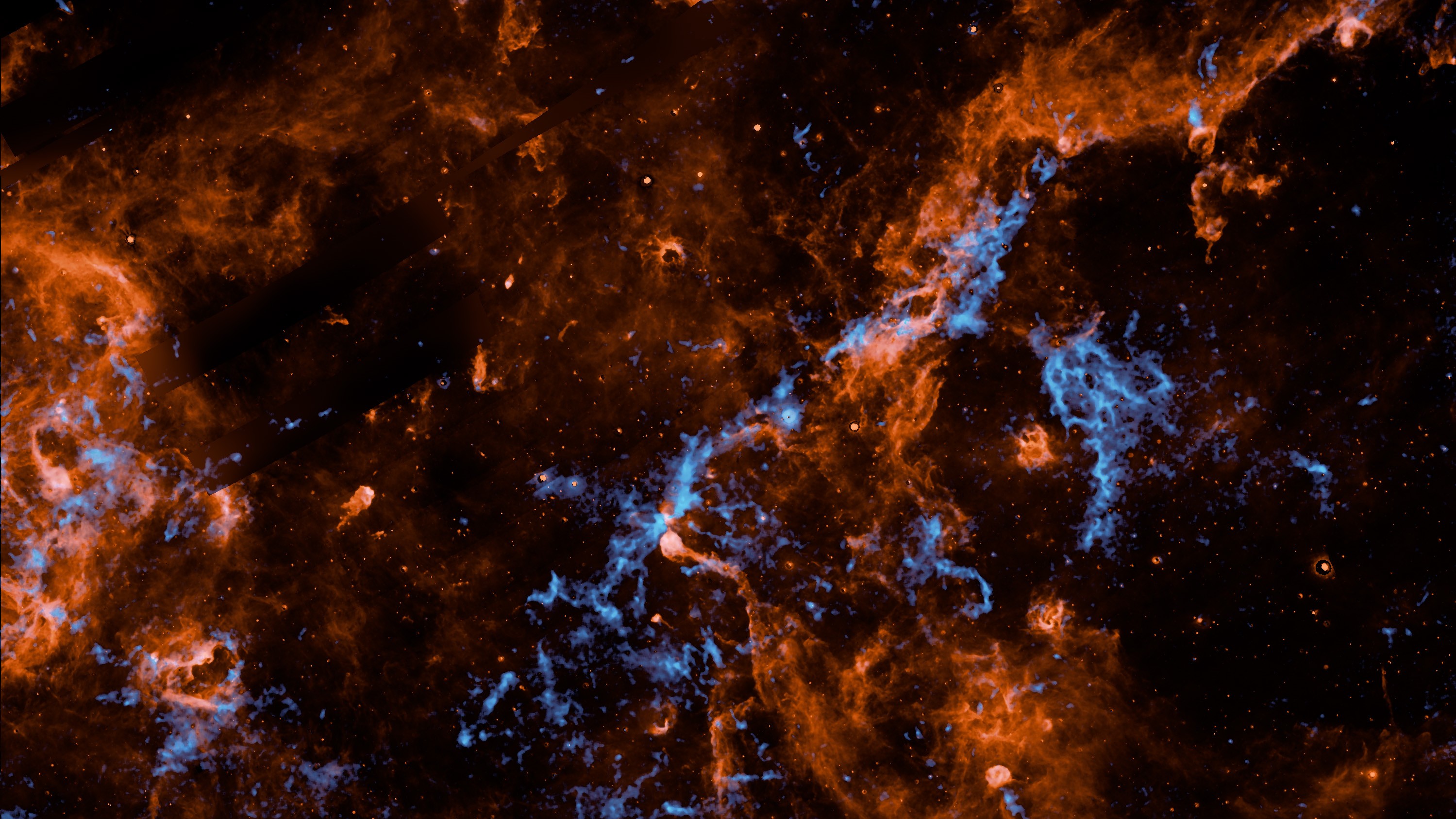
NASA’s SPHEREx (Spectro-Photometer for the History of the Universe, Epoch of Reionization, and Ices Explorer) mission has mapped interstellar ice at an unprecedented scale. Covering regions in our Milky Way galaxy more than 600 light-years across, the ice was found inside giant molecular clouds — vast regions of gas and dust where dense clumps of […]

Scientists have found that young stellar cousins of our Sun are calming down and dimming more quickly in their X-ray output than previously thought, according to a new study using NASA’s Chandra X-ray Observatory. A paper describing the results published Monday in The Astrophysical Journal. Unlike in the new movie “Project Hail Mary,” this quieting […]
Astronomers discovered dozens of stellar streams in the Milky Way using Gaia data, offering new clues about galaxy formation and dark matter.
…
Astronomers have discovered that rapidly spinning extreme dead stars or pulsars push it to the edge, blasting out radio signals from their extremities.
…
Astronomers have used the XRISM X-ray spacecraft to discover a star being devoured by a stellar companion, solving a mystery that has baffled scientists for over 100 years.
…
“Failed star” brown dwarfs may get a second chance to shine by colliding and merging to birth a new star.
“Cosmic archaeologists” have discovered an iron-deficient second-generation star, which provides evidence of how ancient stars enriched their successors.
…
With the help of an extremely powerful telescope deep underground in Japan, astronomers may be able to catch a glimpse of ghost particles from long-dead stars.
…
As binary neutron stars spiral around each other to merge, their gravitational tidal forces distort each other’s shape and structure, potentially revealing clues as to what lies within them.
…
So, why is it that Orion is not always visible in the night sky, and certainly not in the same location month after month, while the Big Dipper always is?
…